The Rupee has fallen around 2.5%, so far, this month. An article in Bloomberg Quint claims that it has been “weighed down by the Turkish lira-led emerging market currency rout.”
A Reuters headline screamed “Equities around the world took a dive led by emerging market stocks on Wednesday and commodities tumbled as investors looked for safety due to worries about China and Turkey.”
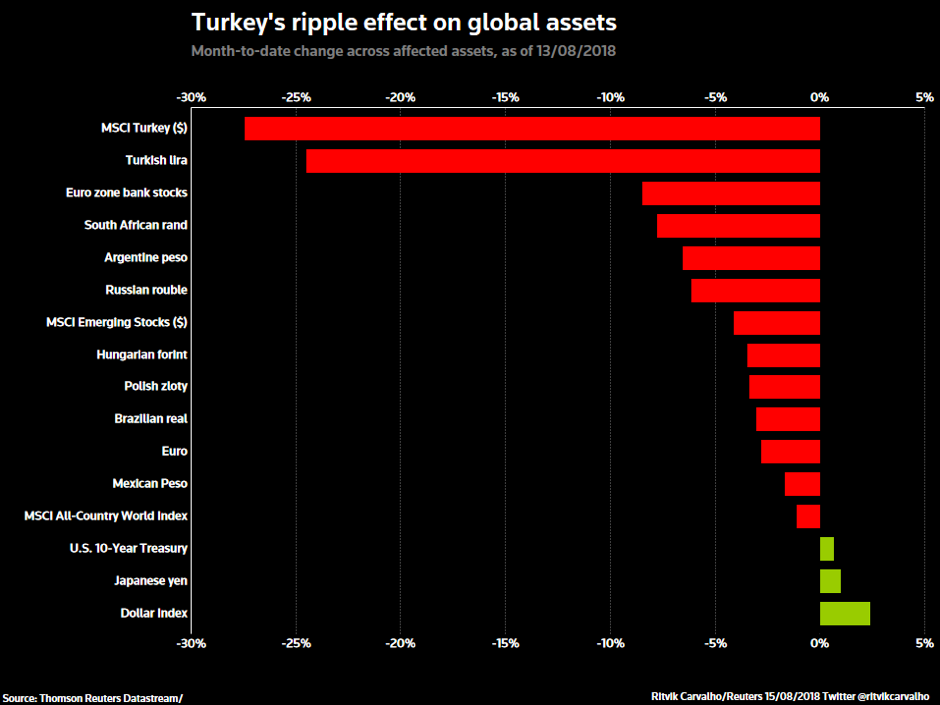
The following Chart, in that same article, highlighted the Impact of Turkey on a few markets.
Sitting in India how can we navigate these issues?
In the third piece in the series of Going to Bed Smarter, I present
- An article on Globalization of stock markets which conclusively shows why we should keep an eye on the global issues.
- A couple of websites that you can visit regularly to see what some of the influential investors are thinking about Global issues.
The Globalization of Financial Markets
In 2001, Lord Robertson, the then Secretary General of NATO said in a speech “Globalisation will make our societies more creative and prosperous, but also more vulnerable.”
He was referring to defence and security but this could easily be applied to Financial markets as well. We are seeing that vulnerability these days!
The impact of Global markets on India is unmistakable. In my piece, Global recovery helped Indian markets in 2017. What about 2018? I had written major driver for the last year returns was what was happening outside India rather than in India.
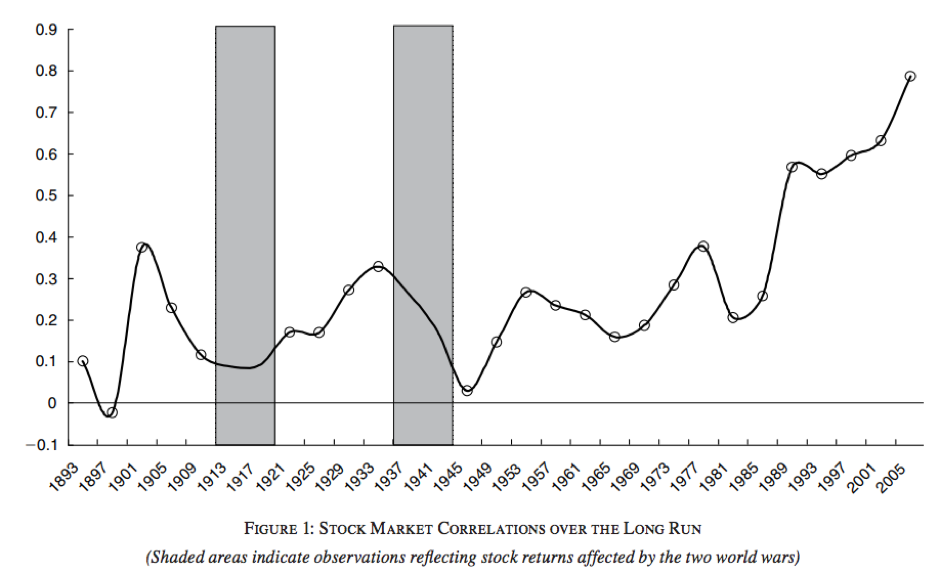
Dennis P. Quinn and Hans-Joachim Voth have written an academic paper which deals with the history of the correlations of Global Stock Markets.
In their paper titled, “A Century of Global Equity Market Correlations”, published in 2008, they came up with the following interesting conclusion: “Over the last century, capital account liberalizations have been accompanied by higher correlations of national stock markets with those abroad. Also, open countries have maintained higher correlation levels than closed ones.”
What is very revealing the following chart in that paper which shows that the Correlation in Global stock markets has increased dramatically since 1985.
So what are the key themes in the world of investing today?
Blackrock’s Insights
BlackRock is the largest asset manager in the world. In December 2017, it had an AUM of $6.3 trillion. It is truly a global firm with 70 offices in 30 countries and clients in 100 countries.
Fortunately, Blackrock shares their insights regularly on their website. For example, their latest weekly commentary can be seen here.
Here are the excerpts:
On Trade War: Rising trade conflicts have been front and center in the markets and the media. So far they have had limited impact on global earnings – or the earnings outlook. There are exceptions: Consumer discretionary firms were among the first to feel the pinch from tariffs. Case in point: Global auto and household appliance makers guided earnings lower after the U.S. slapped tariffs on steel and aluminum imports. Corporate executives in most other sectors are expressing confidence that much of the increased cost can be passed on.
On Markets: We expect earnings growth, dividends and share buybacks – not multiple expansion (rising price-to-earnings ratios) – to drive equity returns over the coming quarters. We see solid fundamentals underpinning global growth and supporting corporate earnings, though geopolitical risks such as trade conflicts are amplifying economic uncertainty. We believe portfolio resilience is critical against this backdrop. We prefer companies with strong balance sheets and solid earnings momentum. We find these primarily in the U.S.
We also like EM equities supported by economic reforms, improving corporate fundamentals and reasonable valuations, but see escalating trade conflicts and a stronger U.S. dollar as potential risks.A currency crisis in Turkey highlights the risks in EM economies dependent on external funding, and argues for a selective approach.
Aberdeen Standard Life Insights
Standard Life Aberdeen plc is one of the world’s largest investment companies, created in 2017 from the merger of Standard Life and Aberdeen Asset Management. They are the largest active manager in the UK and one of the largest in Europe. They have a significant global presence
Like Blackrock they share their insights regularly on their website. Their recent pieceon Emerging Market risk is very illuminating.
Here are the excerpts:
So far, 2018 has been a difficult year for emerging market (EM) assets, which in the last few months have fared significantly worse than their counterparts in developed markets. This has been due mainly to worldwide issues but also country-specific political uncertainty.
They highlight three external factors that are impacting the Emerging Markets:
Rising US interest rates and a stronger dollar– many EMs have large piles of debt denominated in US dollars – when the dollar strengthens, so too does the value of that debt. Another reason why the dollar matters is that a strong dollar can dampen world trade. Additionally, depreciation of an EM currency puts pressure on its central bank to raise interest rates, which can then slow domestic growth.
Slowing industrial growth in China– the weakness in China’s industrial activity has been offset by strength in services, so that overall growth looks healthy. However, the slowdown in the more externally facing industrial sector has spilled over into some weakness in world trade, which affects other EMs.
Trade protectionism– many small, open EMs are disproportionately impacted by recent trade actions. They are affected both directly through the loss of value-add provided to Chinese exporters, and indirectly through the broader move away from multi-country trade systems. Indeed, even before tariffs were implemented, trade flows appear to have been disrupted as sentiment deteriorated.
However, they seem to be pretty bullish over the longer term when they say :
Importantly, we note that, although EM fundamentals have weakened slightly over the past year, they remain healthier than during previous EM crisis episodes.
Thinking Globally
I have presented only some of the resources that are freely available. Of course, there are more such resources and there are some of the global business websites like Bloomberg, CNBC, WSJ, Financial Times and Reuters where one can get regular updates on what is happening globally.
Depending on whether you trade or are a long-term investor you may choose how much time you wish to invest in keeping updated with global trends. But whatever you do, the message I would like to leave you with is that for successful investing it is important to Think Globally.
Also Read
Going to Bed Smarter #1: Selling too Early
Going to Bed Smarter #2: GST Impact

Sanjeev Mohta
Market Expert
Sanjeev Mohta is the Market Expert at Marketsmojo. He has over 27 years’ experience in Investment Research and Fund management across Asian Markets and Asset classes. He has worked in various organisations in Singapore and India like Alchemy, QVT, Jefferies, ABN Amro and HSBC Securities. He Has a PhD in Economics from Tulane University, USA.