“You have power over your mind – not outside events. Realize this, and you will find strength.” Marcus Aurelius
I vividly remember May 14, 2004
The Atal Bihari Vajpayee government, which had done a lot of good work for the economy, lost the elections. Most people were not expecting this election result. The BSE Sensex fell 6%.
By 17th morning it was clear that the NDA would not be part of the new government and Congress would form a government with support from the Left parties.
Everyone was bracing for a market fall and the market did not disappoint! Intraday the Sensex fell 842 points. Over a 2 day period the Sensex fell 16.7%. Since its high on April 24th, the Sensex had fallen close to 25%!
Fast Forward to today: Uncertainty Ahead
Politics is again in everyone’s mind. The media is playing its part it covers every sneeze by any political player. And be rest assured this will only become more pronounced with every passing day. As you are aware, there is the Karnataka election soon and then MP, Rajasthan and Chhattisgarh elections towards the end of 2018 and then the General elections in 2019. Unlike in 2004, we have many more TV channels and then we have the Social Media.
Political Uncertainty started with the bye-election results in Rajasthan in February this year when BJP lost all three elections. It got a brief respite after the North-East election results but of late it has gathered momentum again with UP bye-elections and with TDP withdrawing it alliance with NDA.
Despite the fact that the NDA now has a government in 20 of the 29 states and that according to an India today poll in January, PM Modi still remains hugely popular, there are uncertainties. A few obvious ones:
- The Economy is still in a recovery mode, the initial disruption due to GST is still not over, the Private Sector Capex cycle has still not begun, the PSU Bank clean-up is still underway. All these are not good for the incumbent ruling party.
- To add to that Anti-incumbency is an important factor. In a recent interview, Chief Global Strategist at Morgan Stanley Investment Management, Ruchir Sharma, in a recent interview with CNBC TV18, cited data to say anti-incumbency “is the default option, that is just the history of Indian elections”. It is not as if ruling parties don’t win, but it is much harder as they have to fight an anti-incumbency mind set of the voters.
- Also, based on simple arithmetic, if all the opposition parties, despite their political differences, get together, it will not be easy for NDA. Recent UP bye-elections and the Bihar elections in 2015 showed that.
I am sure there are many other points that can be listed making plausible cases for either outcome but the fact remains that it is very difficult for anyone to predict the results of the elections.
So, what should we as investors do now?
Clearly if 2004 is anything to go by, the market can fall 25% in one month if there is a political shock. This is a big move. Especially If you are a trader and take leverage.
But then why does Ruchir Sharma say: “I think the importance of politics in the India context is way exaggerated. One thing I have learnt over the years is that do not draw any inference from the election results on what is going to happen to the economy or to the markets.”
You need only to look at the past data.
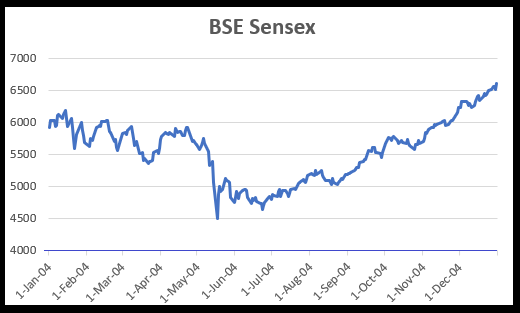
After its fall in May 2004, the BSE Sensex recovered all its losses by the end of the year.More importantly, BSE Sensex more than doubled over the next two years! The global markets did help but the Indian economy did well too. In fact, if you had invested in the BSE Sensex in Jan 2004, much before the elections and woke up in May 2006, two years after the elections not knowing that elections happened, your money would have DOUBLED!
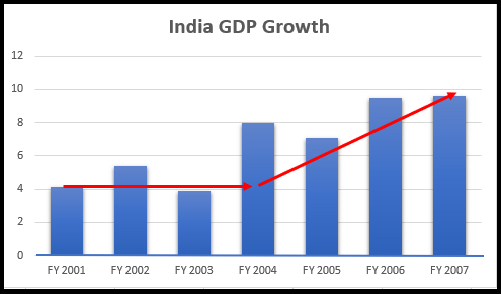
The 2004 story can repeat, at least for the economy
The situation today is very similar to 2004. A lot of work done by the NDA government in 1999-2004 like Golden Quadrilateral, Fiscal consolidation, lower inflation and interest rates, stable currency set a platform for good growth in the subsequent five years.
While the current economic situation is not great, but one can see positive signs. Here are some voices:
- V Vaidyanathan, Executive Chairman of Capital First said in a recent interview that “new sets of initiatives that have rolled out in India over the last few years—digitalization, demonetisation and GST—the ability to finance small entrepreneurs has expanded plentiful. What has not happened in 50 years will happen in the next five years.”
- Romesh Sobti , the CEO of IndusInd Bank in a presentation showed why the Rural economy should do well over the longer term as the government policies of the last few years have set a stage for a long term secular move towards improving the Rural demand and efficiency.
- Prem Watsa Chairman of Fairfax Financials, likened to Warren Buffet by many, in a recent letter to his shareholders said: “We are even more excited about India’s prospects today than we were in 2014.”
In conclusion
Nassim Nicholas Taleb, one of my favourite authors, says “countries that have survived past bouts of chaos tend to be vaccinated against future ones”.
India is a great example of this. We have had a chaotic democracy and a partial free market for decades. In this chaos, the BSE Sensex has gone up 14% compounded over the last 33 years. The red lines indicate Elections.
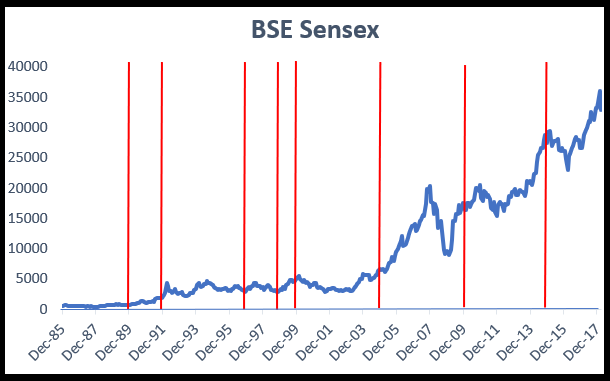
Given the current market conditions, it is very difficult to predict what will happen in the short-term. Both the Indian and the Global markets are going through a difficult phase. Can it get more negative? Possible. But for the longer term investors, the data shows that politics does not matter much and the economy should do well.
Market doubling in two years like in 2004 may be asking for too much, but given the economic outlook, the long-term average of 14% per year return over the next 3-5 years should be possible irrespective of who wins the next elections.
Do let me know what your views are.

Sanjeev Mohta
Market Expert
Sanjeev Mohta is the Market Expert at Marketsmojo. He has over 27 years’ experience in Investment Research and Fund management across Asian Markets and Asset classes. He has worked in various organisations in Singapore and India like Alchemy, QVT, Jefferies, ABN Amro and HSBC Securities. He Has a PhD in Economics from Tulane University, USA.