Philip Fisher has been called the Father of Growth Investing.
I think he should be called the Father of Quality Investing.
He really stressed the importance of the Quality of management when picking stocks. This quote from Philip Fisher is a classic:
“Regardless of how high the rating may be in all other matters, however, if there is a serious question of the lack of a strong management sense of trusteeship for stockholders, the investor should never seriously consider participating in such an enterprise.”
Each time the market turns bearish, it leaves a stark, bleeding reminder that we should have backed companies with great quality management.
As Warren Buffet famously said “Only when the tide goes out do you discover who’s been swimming naked.”
Philip Fisher’s India Portfolio!
Imagine Philip Fisher looking at the Indian stocks today. What stocks would he look at to build a portfolio? And what can we learn from his style of investing?
I attempted to create a list following his advice – and discovered that ONLY 26 companies of the 4500 made it to this list. Before I reveal the names to you – let’s dig deeper into Philip Fisher’s methods.
The Man and his story
Philip Fisher was born in 1907 in San Francisco, California. He began his career at an age of 21, when he decided to drop out of Stanford Business School and took a job as a securities analyst. According to Investopedia, Fisher went on to found his own money management firm, Fisher & Company, in 1931. He managed the company’s affairs until his retirement in 1999 at the age of 91. He passed away in 2004.
Warren Buffet has been using his Methods
Warren Buffett has publicly acknowledged that he has used a good deal of Philip Fisher’s methods into his own stock selection process. Closer home, many of the Dalal Street Wizards have been using his methodology as well.
Philip Fisher’s biggest contribution: Common Stocks and Uncommon Profit.
Philip Fisher shared his methods in vivid details with the rest of the world in his classic 1958 book Common Stocks and Uncommon Profits. Warren Buffett said that the book “ranks behind only The Intelligent Investor and the 1940 edition of Security Analysis is in the all-time-best list for the serious investor.”
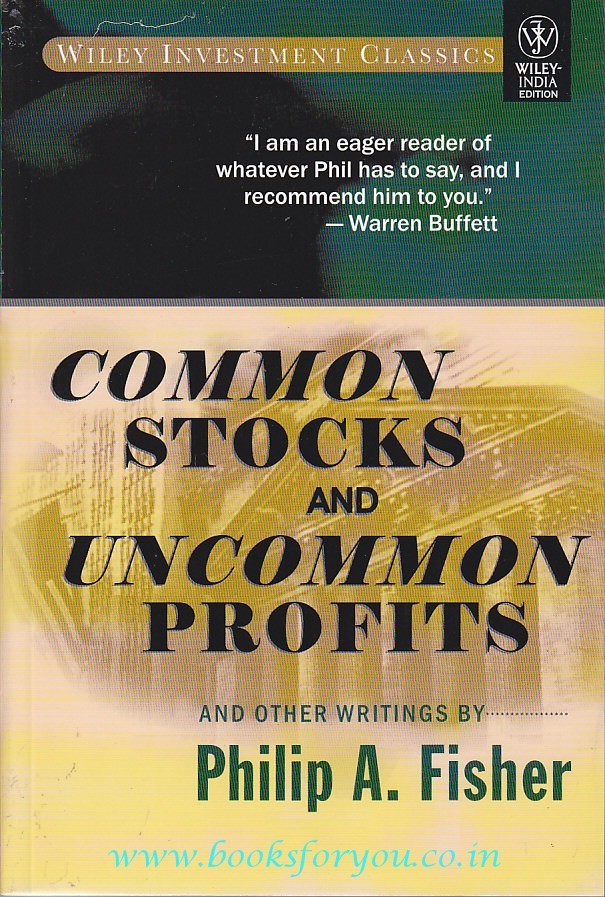
This one line from his book captures Philip Fisher’s entire thesis:
“Purchase and hold for the Long Term a Concentrated Portfolio of Outstanding Companies with Compelling Growth Prospects”
“Investors have been so oversold on diversification that fear of having too many eggs in one basket has caused them to put far too little into companies that they thoroughly know and far too much into others about which they know nothing at all. It never seems to occur to them, much less their advisors, that buying a company without having sufficient knowledge of it may be even more dangerous than having inadequate diversification”
Let’s deconstruct his method:
Outstanding company is largely linked to Management Quality
Philip Fisher had 15 Points to look for in a company. Most of these were to do with Management Quality, Efficiency and Capital Structure. His 15th Point was possibly the most important:
“Does the company have a management of unquestionable integrity?”
Compelling Growth Prospects depends on the Market Potential
“Does the company have product or services with sufficient market potential to make possible a sizeable increase in sales for at least several years?”
Timing the purchase is not relevant
“the opportunities did not require purchasing on a particular day at the bottom of a great panic.” In fact, “if an investor had bought at the absolute lows, it would have been more a matter of luck than anything else.”
Hold the company Forever….
“If the job has been correctly done when a stock is purchased, the time to sell it is — almost never.”
..Unless a Mistake has been made….
“An investor should always realize that some mistakes are going to be made”
He advised selling a stock “when a mistake has been made in the original purchase and it becomes increasingly clear that the factual background of the company is by a significant margin, less favourable than originally believed.”
…Or when Company Fundamentals change
He also advised selling if “Either there has been a deterioration of management, or company no longer has the prospect of increasing the markets for its product in the same way it formerly did”
And when you have to sell, do it even if you are making losses
“More money has probably been lost by investors holding a stock they really did not want until they could ‘at least come out even’ than from any other single reason.”
Thus, Regular monitoring is a must
It is extremely important to “keep at all times in close contact with the affairs of companies whose shares are held.”
I hope this helps in understanding Philip Fisher’s thought Methods. To go deeper into it I would urge you to read this amazing book.
The List
Now back to the Philip Fisher Portfolio. What was the methodology for picking my list? Here goes:
- Choosing Outstanding Companies: At Marketsmojo, one of long term drivers, the Quality Parameter uses multiple Factors like Growth, Efficiency and Capital Structure over the long term and some basic Hygiene factors to rate the companies. The advantage of this data driven approach is that it takes out the human bias from our analysis. All the hard work is done by the algorithm, my job of picking the best companies was easy, I only chose those companies which we categorize as “EXCELLENT”.
- Compelling Growth Prospects: For this, one needs to be able to forecast the future. But as Legendary Danish Physicist Neils Bohr humorously said “it is very difficult to predict — especially the future.” Also, Warren Buffet said : “Forecasts may tell you a great deal about the forecaster; they tell you nothing about the future.”
Given this difficulty, we made a simple assumption that the past performance is the best guess of the future. Thus given that long term profitable growth is one of our Quality parameter, these Excellent Quality companies can be assumed to be the ones who have “compelling growth prospects”. This is possibly truer in India as the economy is still a nascent growth economy and most industries are in a growth phase and not in a mature phase.
Only 26 stocks out of around 4500 stocks made this list! Here goes:
| Company | Market Cap | Market Cap | Return- YTD | Return- 5yrs |
|---|---|---|---|---|
| Bajaj Finance | 1,54,474 | Large Cap | 53.12% | 2249.14% |
| TVS Motor Company | 25,132 | Large Cap | -33.18% | 1562.42% |
| Tata Elxsi | 9,024 | Mid Cap | 45.27% | 1424.72% |
| VIP Industries | 6,900 | Mid Cap | 40.74% | 941.41% |
| Britannia Industries | 78,034 | Large Cap | 36.33% | 818.96% |
| Eicher Motors | 78,361 | Large Cap | -8.13% | 697.92% |
| Maruti Suzuki | 2,82,143 | Large Cap | -2.67% | 613.68% |
| Page Industries | 32,079 | Large Cap | 15.16% | 567.34% |
| Natco Pharma | 14,387 | Mid Cap | -18.63% | 542.34% |
| IndusInd Bank | 1,17,972 | Large Cap | 19.64% | 408.64% |
| Pidilite Industries | 59,962 | Large Cap | 23.54% | 315.44% |
| Kotak Mahindra Bank | 2,52,159 | Large Cap | 29.86% | 302.60% |
| Mindtree | 15,447 | Mid Cap | 51.38% | 286.16% |
| Procter & Gamble | 34,266 | Large Cap | 10.93% | 269.84% |
| HDFC Bank | 5,82,383 | Large Cap | 15.76% | 255.72% |
| Marico | 47,530 | Large Cap | 12.15% | 244.01% |
| Titan Company | 76,305 | Large Cap | 5.05% | 241.45% |
| Gillette India | 21,662 | Large Cap | -1.49% | 210.95% |
| HUL | 3,61,407 | Large Cap | 24.59% | 177.85% |
| HDFC | 3,44,313 | Large Cap | 15.38% | 146.84% |
|
BSE 500 |
1.81% | 118.66% | ||
| Tech Mahindra | 61,629 | Large Cap | 35.16% | 118.48% |
| TCS | 7,49,539 | Large Cap | 42.98% | 112.72% |
| HCL Tech | 1,33,671 | Large Cap | 7.20% | 103.63% |
| Hero MotoCorp | 63,408 | Large Cap | -13.73% | 79.55% |
| ITC Ltd | 3,67,060 | Large Cap | 13.11% | 30.66% |
| CG Consumer Electrical | 15,156 | Mid Cap | -12.83% | – |
What do you think?
The list can easily be viewed using our Screener. You can use this method as a starting point to do further research on Marketsmojo and create your own list.
If you look at any stock from a long-term perspective do spend some time to figure out if the management has integrity and acts in the best interest of shareholders.
Happy Investing!

Sanjeev Mohta
Market Expert
Sanjeev Mohta is the Market Expert at Marketsmojo. He has over 27 years’ experience in Investment Research and Fund management across Asian Markets and Asset classes. He has worked in various organisations in Singapore and India like Alchemy, QVT, Jefferies, ABN Amro and HSBC Securities. He Has a PhD in Economics from Tulane University, USA.