“More money has been lost trying to anticipate and protect from corrections than actually in them.” Peter Lynch
The Right Stock..But the Wrong Return!
Below is the chart of one of the best performing large cap companies.Asian Paints, as most of you are aware, is well-known paints company. You cannot miss its most successful ad campaign if you watch Television.This is an “Excellent” Quality company, it is a market leader with high growth.
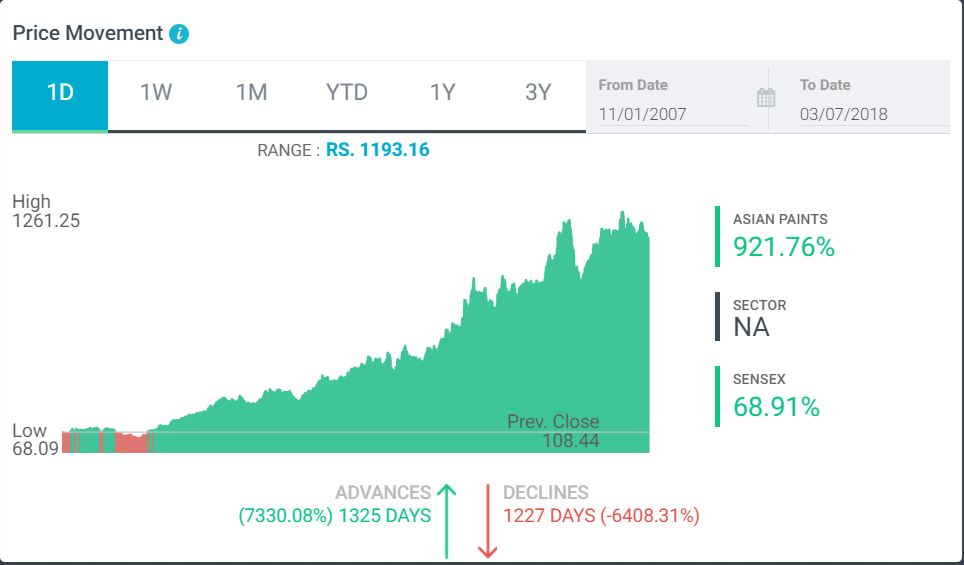
The stock has gone up almost 10x in the last 10 years. Put another way, the stock has gone up at a compounded annual rate of 26%, without considering dividends, for the last 10 years. A great stock for any buy & hold investor and as mentioned in my last piece someone who held on to such a stock for the entire period would have done extremely well due to the power of compounding.
While the stock has given an annualised 26% return it has not done so in a consistent bond-like way. Interestingly you can see from the above graph that while the stock went up on 1325 days it also went down on 1227 days! The reality is that stocks go through periods where values decline or stay flat. These periods could be long and declines can be huge. We are going through one such period right now. The key is how do we react to these declining and flat periods and that determines what return we ultimately get.
Let us assume that you decided to put Rs. 100 each in stock market and in a Fixed Deposit in November 2007. For the stock market allocation you had rightly identified Asian Paints and invested Rs. 100 in the stock. Fast forward 18 months. In May 2009, the Asian Paints stock was worth 80. And your Fixed Deposit was worth Rs 110. So, after 18 months you were down 20% in your stock market allocation.
In this particular case, the reason for the fall was nothing to do with Asian Paints, the stock was down due to Global Financial Crisis. With all the negative news floating around that time what would you have done? If you were like the majority, you would have either booked your loss or would be very tempted to. Even if you did not book the loss, you may wait for the first opportunity when the stock is back at your cost price to get out feeling good that you did not lose money.
If you had booked your loss or got out at cost price and not invested again, you would have been in the RIGHT stock but would have got the WRONG return.
Peter Lynch said it well, “You get recessions, you have stock market declines. If you don’t understand that’s going to happen, then you’re not ready, you won’t do well in the markets.”
Now Asian Paints, has been much less volatile than most typical stocks. The Stocks that gave at least a 50% compounded return over the last 10 years, which I had covered in my last piece, each had at least one fall of around 50% from their last peak sometime in that 10-year incredible journey. The more the volatility the higher the temptation to sell when things go wrong.
A Buy & Hold Investor would do well to take Warren Buffet’s advise “Unless you can watch your stock holding decline by 50% without becoming panic stricken, you should not be in the stock market.”
Do you have, what it takes?
Many investors who claim to be Buy and Hold investors change their mind after large losses. To hold stocks in the midst of market volatility and regular barrage of negative news-flow is not easy at all.
While I have only discussed the fear due to negativity but sometimes the Fear could also be that of losing the gains. For example, if the gain comes too fast we end up booking profits as there is a FEAR that we will lose the gains as quickly as they came!
Suffice to say that Emotions like Greed and Fear, mental strength, and individual personality traits end up playing a huge role in the decision making and override rational investing decisions. The billionaire investor Howard Marks interestingly said “The discipline which is most important in investing is not accounting or economics, but psychology”
Thus, once the right stock is identified, the most important trait required for a successful Buy & Hold Investor is Strong Emotional Control
This trait is very difficult to find. Possibly the main reason why investors who have this trait do so well is that the majority of us lesser mortals do not possess these attributes.
Of course, I have assumed here that the “right” stock has been identified. In my last piece in the series, I will dwell on this point.

Sanjeev Mohta
Market Expert
Sanjeev Mohta is the Market Expert at Marketsmojo. He has over 27 years’ experience in Investment Research and Fund management across Asian Markets and Asset classes. He has worked in various organisations in Singapore and India like Alchemy, QVT, Jefferies, ABN Amro and HSBC Securities. He Has a PhD in Economics from Tulane University, USA.