In my last MojoTalk I had put Investment Styles in two main buckets. Buy & Hold Investing and Active Investing. The Buy & Hold type of Investors, as the name suggests, like to hold their stocks for a long period.
Why Buy & Hold ?
- There are clear advantages of Buy and Hold Investing.
- On paper, it is easy to implement: just Buy and Hold!
- It saves on taxes. Long term capital gains are taxed at a lower rate and Regular Dividends add to the returns
- It is efficient as it saves on transaction costs like brokerage, and
- It avoids the headache for trying to time the market
And if you manage to buy the right stock, the biggest benefit of BUY & Hold is the Power of Compounding
“The effects of compounding even moderate returns over many years are compelling, if not downright mind boggling” Seth Klarman
Lets look at an example, Mr. A and Mr. B had a job in a tech company. In January1998 and both of them got a bonus of Rs.100,000 each to save the amount as they did not need the money in the near future. They were friends but had different risk dispositions.
Mr. A decided to put the money in Fixed Deposit in HDFC Bank and Mr. B decided to put the money in the stock market.
Let us assume that on an average the Fixed Deposit gave a post-tax return of 6% every year and the stock market gave a return of 13% every year (assuming no dividends).
When Mr. A and Mr. B exchanged notes at the beginning of 2018 guess what they discovered?
Mr A’s 100,000 in Fixed Deposit had become Rs. 311000 or 3.1x his initial investment. Mr. B’s 100,000 in the stock market was worth Rs 11,00,000 or 11x his initial wealth. This is not even counting any dividends you may have received. THIS IS THE POWER OF COMPOUNDING.
In fact, the interesting part here is that this is something Mr. B had done without taking too much risk. He invested in a fund which gave exactly the same returns as the BSE Sensex over the 20 years.
But wait, there was also Ms C, who also got the same bonus but instead of putting money in HDFC Bank fixed deposit, bought the HDFC Bank stock and held on to it till today. Now HDFC Bank has given Compounded Annual return of 28% over the last 20 years. This is 15% higher than the 13% Compounded Annual return of the BSE Sensex.
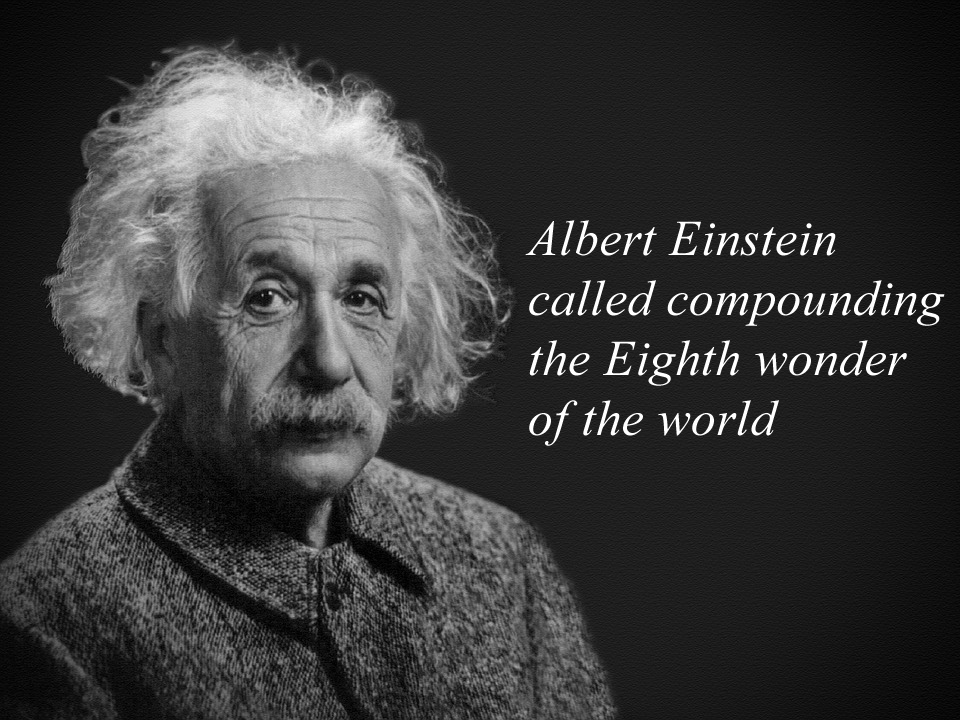
Ms C’s Rs. 100000 invested in HDFC Bank in 1998 is now Rs.1.4 crore without considering the dividends. Ms C’s return in effect is 140 times your money or 12.5x more than Mr. B’s Of course Ms. C was lucky and she picked the right stock, but by any account this is staggering. No wonder Albert Einstein called compounding the Eighth wonder of the world.
While all the above are fictional characters, real life stories of similar nature abound.
Grace Groner’s story has often been quoted to showcase the power of compounding. in 1931, Abbott Laboratories hired Mr Groner as a secretary.
In 1935, four years after she started her job at Abbott Labs, she decided to buy $200 worth of Abbott Lab shares. Ms. Groner was one of the truest Buy & Hold investor. She NEVER sold those shares. Through dividends, bonuses and dividend reinvestmet when she died in 2010, her $200 purchase was worth $7 million. Sounds unbelievable? Lets do some simple Math. Remember, this was over a period of 75 years. All it required was a compounded growth of 15% for the $200 to become $7 million.
While HDFC Bank has given a return of 28% CAGR over the last 20 years, here is a list of the companies among BSE 500 with returns higher than 50% CAGR over the last 10 years.
| Company | 10 year CAGR Returns |
| Symphony | 84% |
| Avanti Feeds | 80% |
| Caplin Point Labs | 79% |
| PI Industries | 63% |
| Relaxo Footwears | 62% |
| Ajanta Pharma | 61% |
| La Opala RG | 59% |
| Eicher Motors | 57% |

Sanjeev Mohta
Market Expert
Sanjeev Mohta is the Market Expert at Marketsmojo. He has over 27 years’ experience in Investment Research and Fund management across Asian Markets and Asset classes. He has worked in various organisations in Singapore and India like Alchemy, QVT, Jefferies, ABN Amro and HSBC Securities. He Has a PhD in Economics from Tulane University, USA.